

Chicago at a Crossroads: Business Pessimism, Political Momentum, and a City Watching Washington
By: Thom Serafin
May 20, 2026

The May Serafin Power Poll arrives at a moment of mounting uncertainty for Chicago. Business leaders are skeptical; political reshuffling is underway, and a global health scare is being watched carefully but not yet felt on the ground. Across all six questions, the same theme surfaces: confidence is in short supply, and Chicago’s decision-makers are demanding more from the systems that govern them.
Question 1
Looking ahead to 2027, how would you rate your confidence in Chicago’s overall business climate and its ability to support growth, investment, and employer retention?
- 8% — High Confidence
- 22% — Moderate Confidence
- 11% — Neutral
- 39% — Low Confidence
- 20% — Very Low Confidence

The numbers are sobering. Nearly six in ten respondents express either low or very low confidence in Chicago’s business climate, heading into 2027. Only 8% say they have high confidence, and just 30% register even moderate or high optimism combined. Neutral sentiment sits at 11%, suggesting most respondents have moved past ambivalence and settled into concern.
Chicago’s business community is watching decisions around taxation, public safety, and fiscal management closely, and the results suggest that many are not yet persuaded the city is on the right trajectory. For a city competing nationally for headquarters relocations, talent, and capital, a confidence gap of this magnitude warrants sustained attention.
Question 2
Which factor most influences your confidence level in Chicago’s 2027 business climate?
- 7% — Commercial Real Estate and Downtown Recovery
- 29% — Economic Conditions
- 6% — Infrastructure and Transportation Reliability
- 24% — Public Safety and Quality-of-Life Considerations
- 9% — Regulatory and Permitting Environment
- 11% — Workforce and Talent Dynamics
- 14% — Other (Please Specify)
 Economic conditions lead to the primary driver of business sentiment at 29%, followed closely by public safety and quality-of-life considerations at 24%. Together, these two factors account for more than half of all responses and paint a clear picture of what Chicago’s leaders believe is holding the city back.
Workforce and talent dynamics register at 11%, and regulatory and permitting concerns at 9%, both areas that businesses often cite in relocation and expansion decisions. Downtown recovery and infrastructure trail at 7% and 6% respectively, which may reflect a broader view that those issues may be symptomatic. The 14% who selected “Other” likely captured concerns ranging from political leadership to fiscal governance, areas that do not fit neatly into predefined categories but weigh heavily on decision-makers.
Question 3
Chicago’s political landscape is already shifting ahead of the 2027 mayoral race. Which of these potential candidates do you believe are most likely to emerge as the top three contenders?
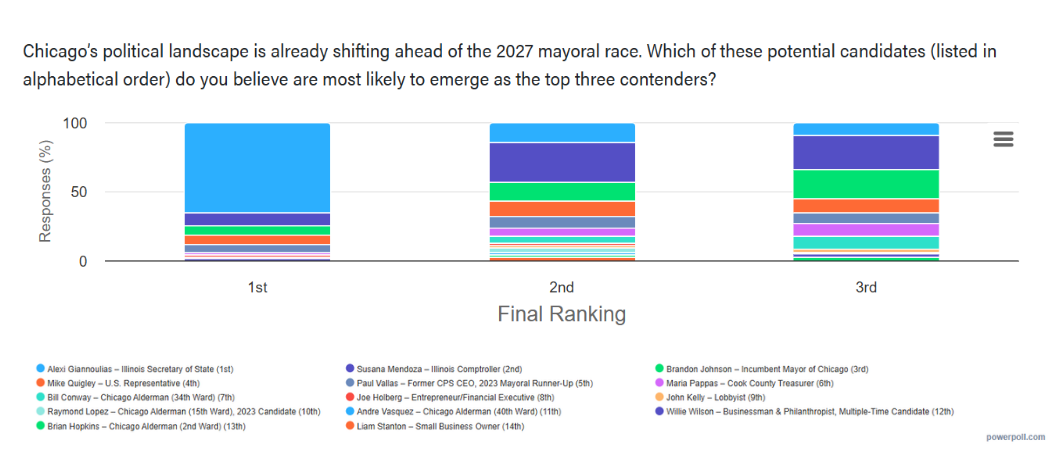
Respondents show an unusual level of early agreement about the top three candidates emerging in the 2027 Chicago mayoral field with Secretary of State Alexi Giannoulias out front, with State Comptroller Susana Mendoza in second, and Mayor Brandon Johnson third.
65% of our Power Pollers selected the Secretary of State, Alexi Giannoulias first. For the second slot, State Comptroller Susana Mendoza leads at 28%, followed by Brandon Johnson (14%) and Mike Quigley and Paul Vallas (each 9%). In the third position, Mendoza again leads with 25%, with Johnson at 19% and Quigley at 11%.
Overall, respondents believe Giannoulias, Mendoza, and Johnson will emerge as the top three contenders for Mayor of Chicago.
Question 4
A recent Hantavirus outbreak on an Atlantic cruise ship has drawn global attention, though public health officials say the risk to Chicago remains low. How confident are you in the federal government’s public health system to monitor and communicate emerging global health threats?
- 15% — Very Confident
- 22% — Somewhat Confident
- 7% — Neutral
- 31% — Not Very Confident
- 25% — Not Confident
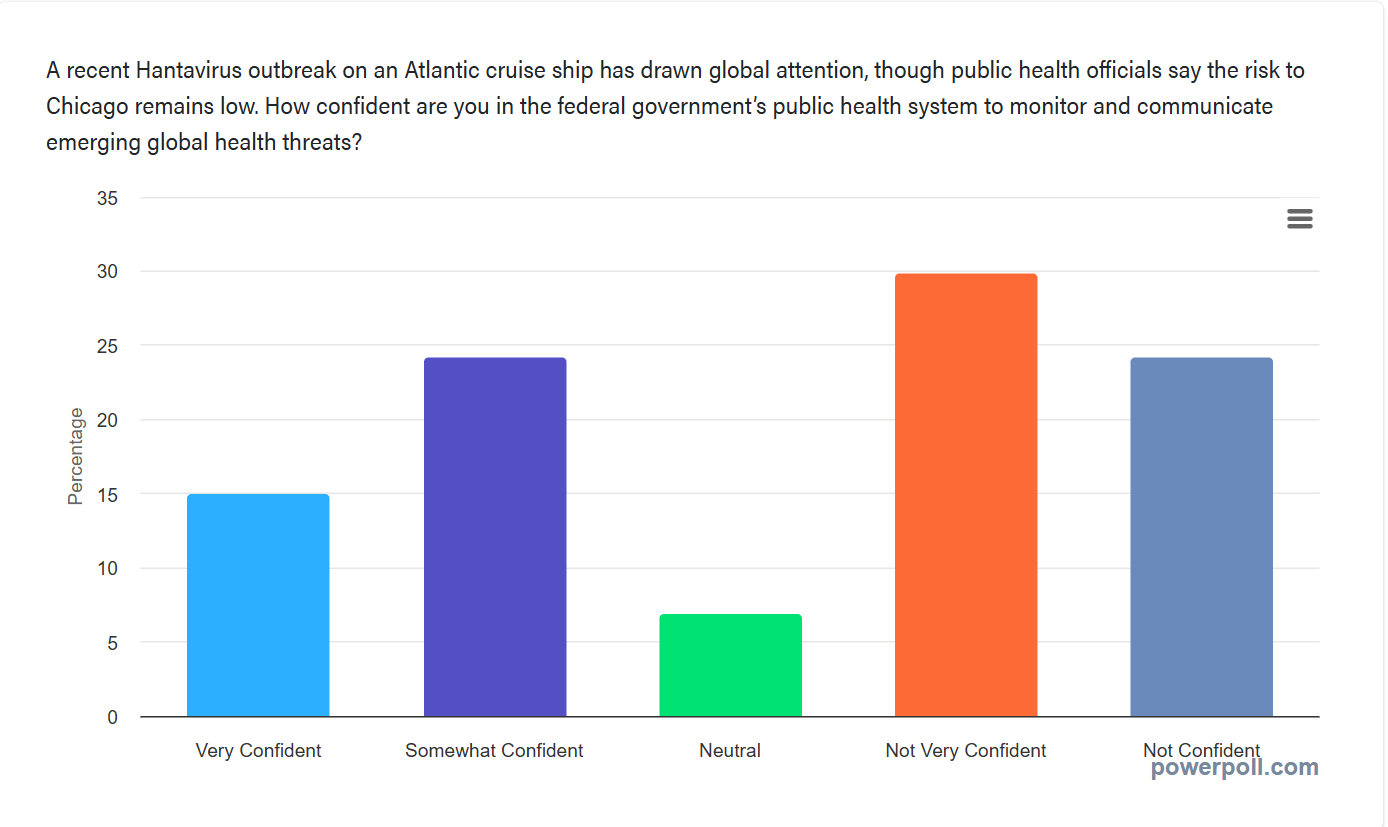 With a Hantavirus outbreak attracting international headlines, respondents were asked about their confidence in the federal government’s public health infrastructure. The results reflect a trust deficit that goes beyond the current outbreak: 56% say they are either not very confident or not confident at all. Only 37% express meaningful confidence, and just 15% say they are very confident.
Post-pandemic skepticism about government health communication clearly continues to shape how decision-makers assess institutional readiness. Given the ongoing debates around public health agency leadership and institutional restructuring at the federal level, these results clearly exemplify major concerns about whether the systems in place are adequately resourced and credible.
Question 5
Has the outbreak influenced your upcoming travel, event-hosting, or public-facing decisions?
- 1% — Yes
- 2% — Somewhat
- 21% — Not Directly
- 74% — No
- 1% — Not Applicable
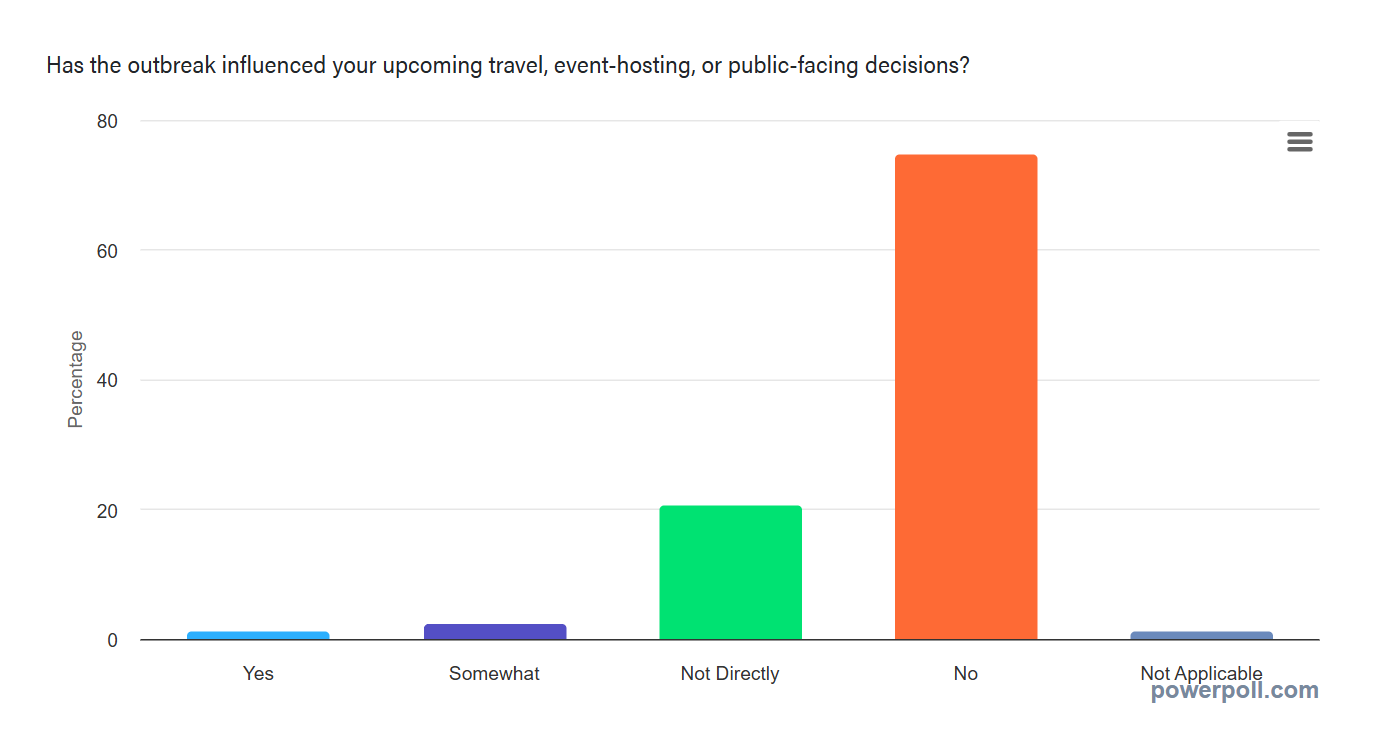 Despite the skepticism about federal health systems, respondents are not changing their behavior. A striking 74% say the outbreak has not influenced their plans, and only 3% report any direct or indirect adjustment. The 21% who selected “Not Directly” likely represents a watching-close posture aware but not yet acting.
This gap between institutional skepticism and behavioral response is instructive. Chicago’s business and civic leaders are not panicking, but they are paying attention.
Question 6
Given the opportunity, who would you most like to have dinner with from the President’s Cabinet?
- 13% — J.D. Vance, Vice President
- 31% — Marco Rubio, Secretary of State
- 1% — Pete Hegseth, Secretary of Defense
- 2% — Robert F. Kennedy Jr., Secretary of Health and Human Services
- 11% — Scott Bessent, Secretary of the Treasury
- 42% — None of Them
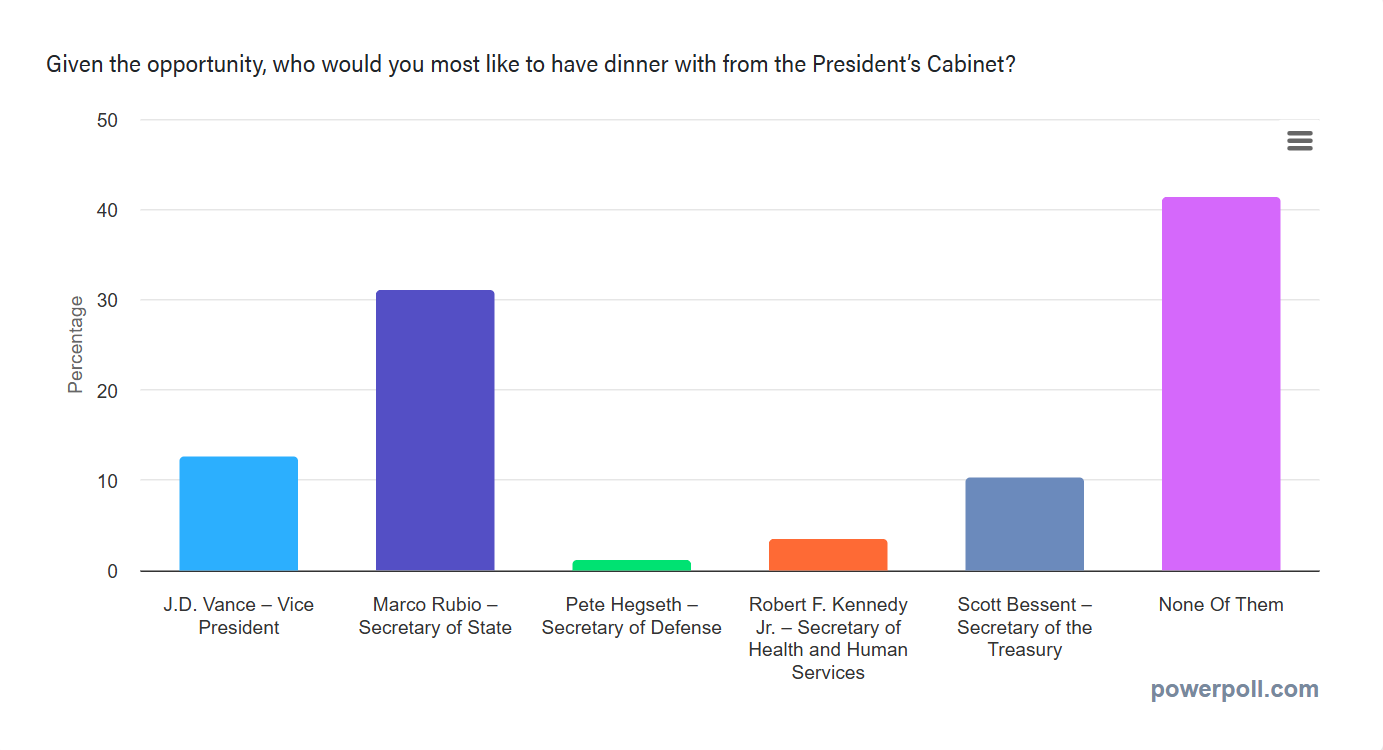 The last question of the poll carries a telling undertone. The most popular answer, at 42%, is “None of Them” — a response that in a heavily Democratic city like Chicago is not entirely surprising yet is worth noting as a signal of how the current administration is perceived among regional influencers.
Among those who would accept the invitation, Marco Rubio leads at 31%, which likely reflects his profile as the most globally engaged Cabinet member and someone with broad name recognition beyond partisan lines. Scott Bessent draws 11%, consistent with the interest in economic conditions seen throughout the poll. J.D. Vance at 13% rounds out the top tier. Pete Hegseth and Robert F. Kennedy Jr. register at 1% and 2%, respectively.
The Takeaway
May’s Power Poll tells a story of a city that is clear-eyed and cautious. Business confidence is low, the political field may be crystallizing earlier than expected, and trust in federal health institutions has eroded in ways that predate any single outbreak. Leaders are watching, assessing, and holding their positions.
The 2027 cycle, for both the mayor’s office and the business environment — is already being shaped by the conversations happening in boardrooms, civic halls, and industry tables across the metropolitan area. Chicago’s decision-makers are engaged and waiting to see whether the city’s and state’s leadership can match the moment.
The Serafin Power Poll sponsored by Mercury Public Affairs captures the perspectives of regional decision-makers and thought leaders in the Chicago metropolitan area. While not a scientific survey, it offers a clear and insightful gauge of prevailing sentiments, much like a reliable weathervane tracking the direction of Chicago’s winds.
Share this Post
