Chicago’s Priorities, Pressures, and Political Frustrations: What October’s Power Poll Reveals
By: Thom Serafin
November 2, 2026
Listen To Podcast

From mounting property taxes and public safety concerns to the future of Chicago’s schools, the challenges facing the Windy City are hardly unfamiliar. What remains less certain is which issues deserve the most urgent attention from City Hall, and whether Chicago’s leaders are listening.
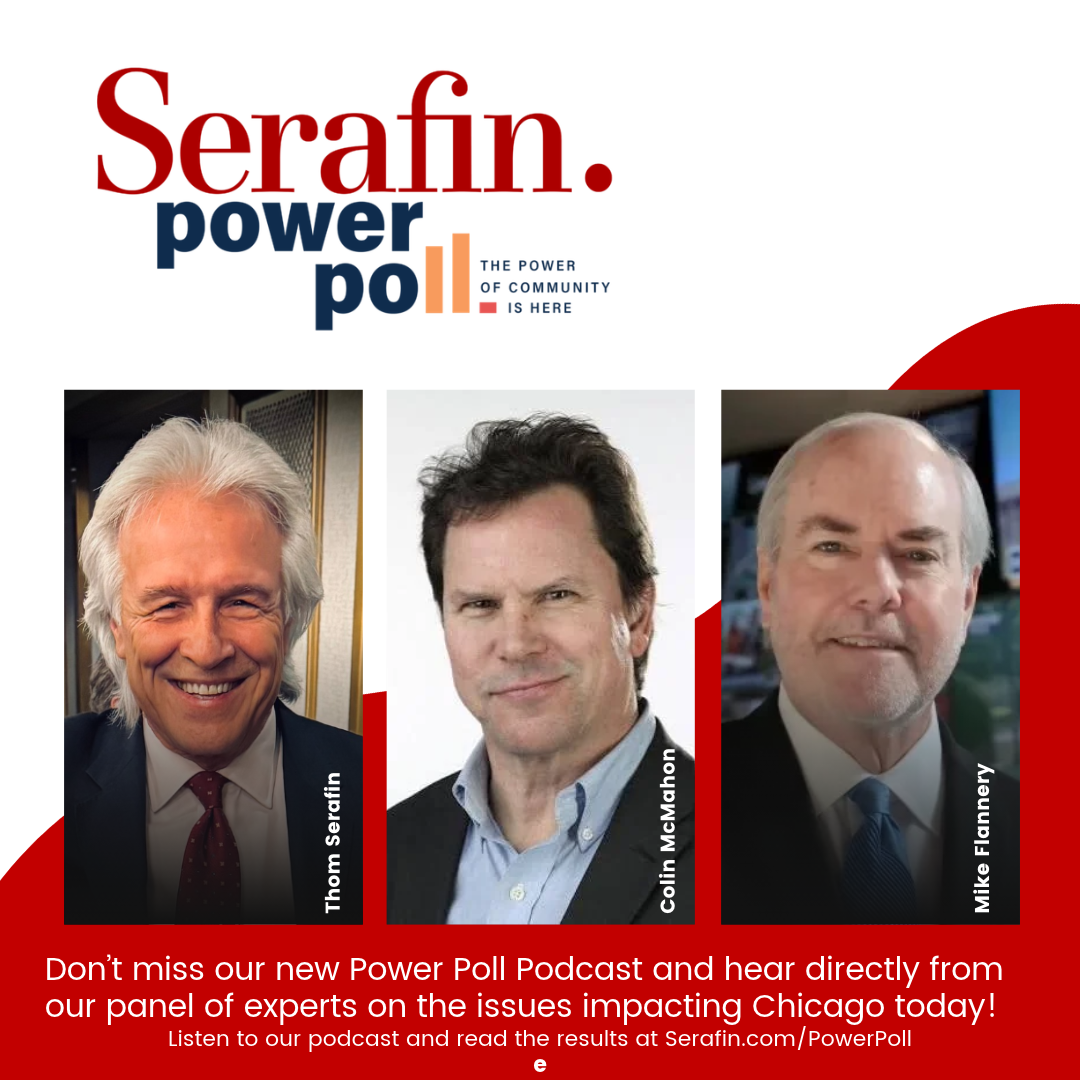
This month’s Serafin Power Poll, sponsored by Mercury Public Affairs, takes the temperature of Chicago’s civic and political landscape, asking local decision-makers to weigh in on the issues shaping the city’s present and future. Our Power Pollers offered their perspectives on everything from the motivations behind residents’ departures to the conversations city leaders may be avoiding. And with Halloween just around the corner, respondents also considered whether the city should rethink its trick-or-treating traditions.
The results reveal a mix of fiscal frustration, concern for public safety, and a desire for meaningful progress, with some surprising distinctions between the problems Power Pollers see today and the priorities they envision for tomorrow.
QUESTION 1: What is the biggest issue Chicago leaders are not addressing effectively enough?
-
Public safety and crime – 29%
-
Property taxes and affordability – 29%
-
Public schools – 19%
-
Homelessness and mental health – 11%
-
Public transportation and infrastructure – 2%
-
Government accountability – 10%
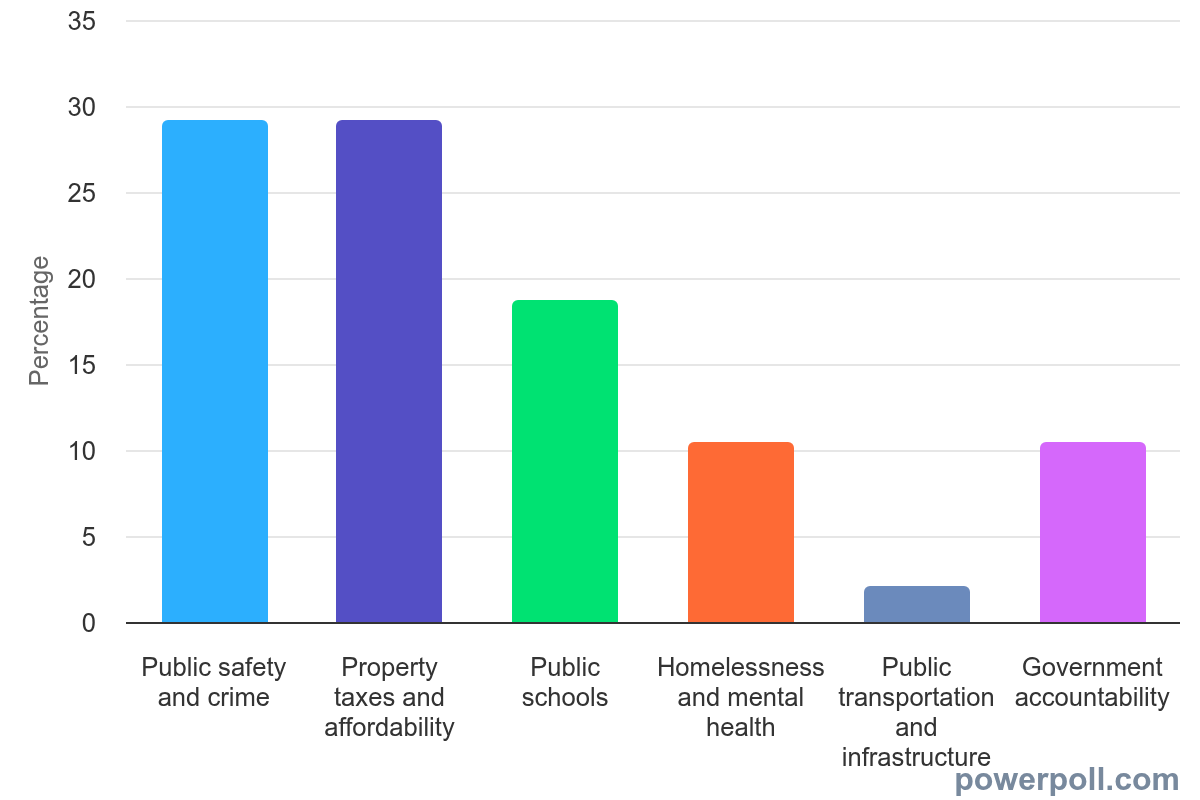
Chicago’s Power Pollers are divided over which challenge City Hall is most urgently failing to address, with public safety and crime tying property taxes and affordability at 29% apiece.
Public schools followed at 19%, while homelessness and mental health received 11% and government accountability garnered 10%. Public transportation and infrastructure finished a distant last at 2%.
The tie at the top speaks to two concerns that have become increasingly intertwined in discussions about Chicago’s future: the cost of living in the city and the confidence residents have in their safety. For homeowners weighing rising tax obligations and families evaluating the security of their neighborhoods, both issues have immediate implications for daily life.
Perhaps equally telling is the prominence of public education, which nearly one in five Power Pollers identified as an area requiring more effective leadership. Together, the results suggest that Chicago’s challenges extend beyond any single policy debate. Rather, respondents are looking for improvements in the fundamental services and conditions that make a city an attractive place to live, work, and raise a family.
QUESTION 2: Why do you think people are leaving Chicago?
-
Property taxes are too high – 17%
-
Cost of living is too expensive – 11%
-
Crime and safety concerns – 22%
-
Better opportunities elsewhere – 7%
-
Frustration with city leadership – 20%
-
Weather and quality-of-life factors – 1%
-
People aren’t leaving as much as the media suggests – 22%
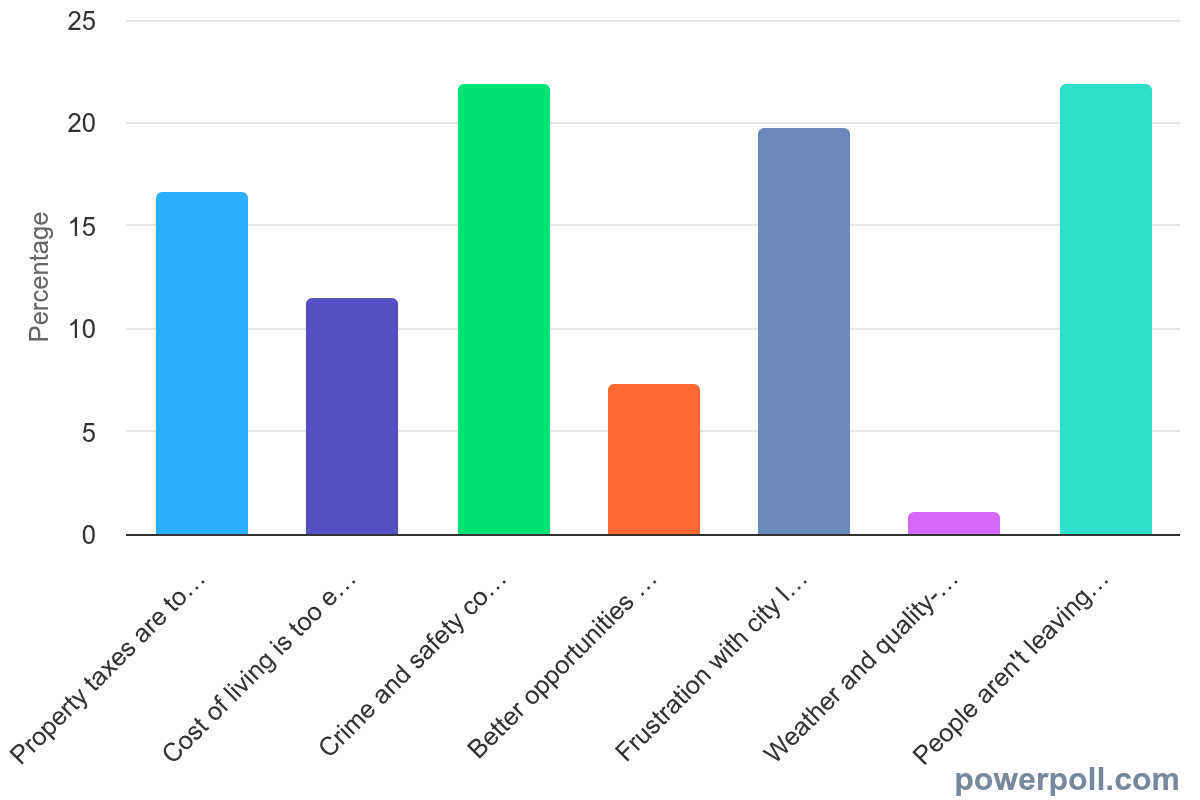
Chicago’s population narrative has long inspired competing interpretations, and this month’s Power Poll suggests that even the premise of the conversation remains unsettled.
Crime and safety concerns tied for the leading response at 22%, alongside an equally sizable contingent of Power Pollers who believe people aren’t leaving Chicago as much as media coverage suggests.
Frustration with city leadership followed closely at 20%, while 17% pointed to high property taxes and another 11% cited the broader cost of living. Better opportunities elsewhere accounted for 7%, and weather and quality-of-life factors received just 1%.
The results expose an intriguing contradiction. While some Power Pollers view public safety as a significant motivation for leaving Chicago, just as many question the narrative surrounding departures in the first place. This divergence reflects the difficulty of separating the city’s measurable challenges from the perceptions that shape its reputation.
Yet the 20% citing frustration with city leadership offers another dimension to the discussion. For these respondents, the question is not merely whether Chicago remains affordable or safe, but whether its government is demonstrating the capacity to address those concerns.
In a city accustomed to spirited debates over its future, the findings suggest that confidence in leadership may be nearly as consequential to perceptions of Chicago’s appeal as the challenges themselves.
QUESTION 3: What topic do Chicagoans need to have a more honest conversation about?
-
Crime and policing – 14%
-
Immigration – 5%
-
Taxes and government spending – 42%
-
Public education – 15%
-
Race and neighborhood inequality – 13%
-
Housing affordability – 9%
-
Political corruption – 2%
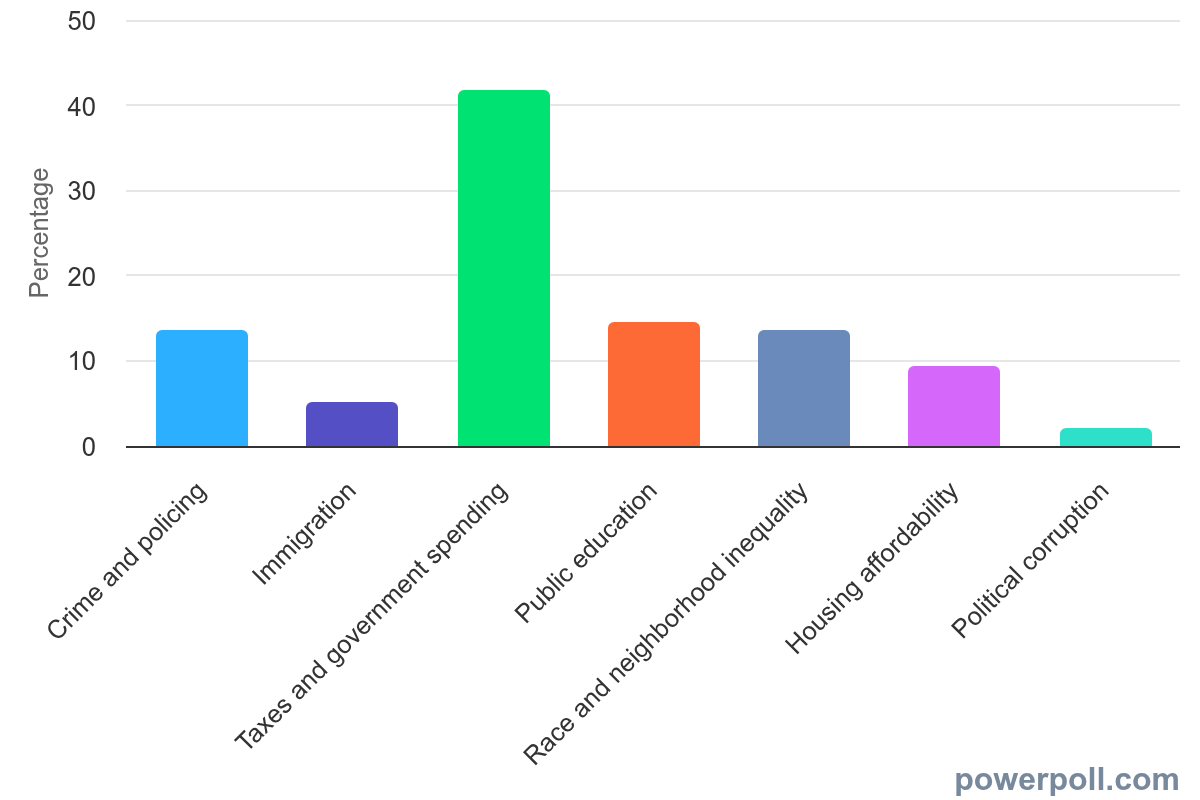
If there is one subject the Power Pollers believe deserves a more candid discussion, it is the city’s finances.
A commanding 42% selected taxes and government spending, far outpacing every other response. Public education came in second at 15%, followed by crime and policing at 14%, race and neighborhood inequality at 13%, and housing affordability at 9%. Immigration garnered 5%, while political corruption received 2%.
The margin is striking. With more than four in ten respondents pointing to taxes and spending, fiscal policy emerged as the issue most in need of an open and substantive conversation.
The result is particularly revealing when considered alongside the first question, where property taxes and affordability tied public safety as the most inadequately addressed concern. Chicago’s Power Pollers appear interested not only in the financial pressures facing residents, but also in how public dollars are collected, allocated, and spent.
Chicago’s fiscal challenges involve difficult trade-offs between sustaining public services, meeting financial obligations, and limiting the burden on taxpayers. The results suggest that respondents want those trade-offs discussed more plainly, with greater attention to what the city can afford and what its residents can reasonably be expected to shoulder.
QUESTION 4: If City Hall could solve ONLY ONE major issue in the next five years, what should it be?
-
Reducing violent crime – 20%
-
Lowering taxes – 17%
-
Improving public schools – 24%
-
Expanding affordable housing – 9%
-
Improving public transportation – 2%
-
Creating more good-paying jobs – 17%
-
Restoring trust in government – 11%
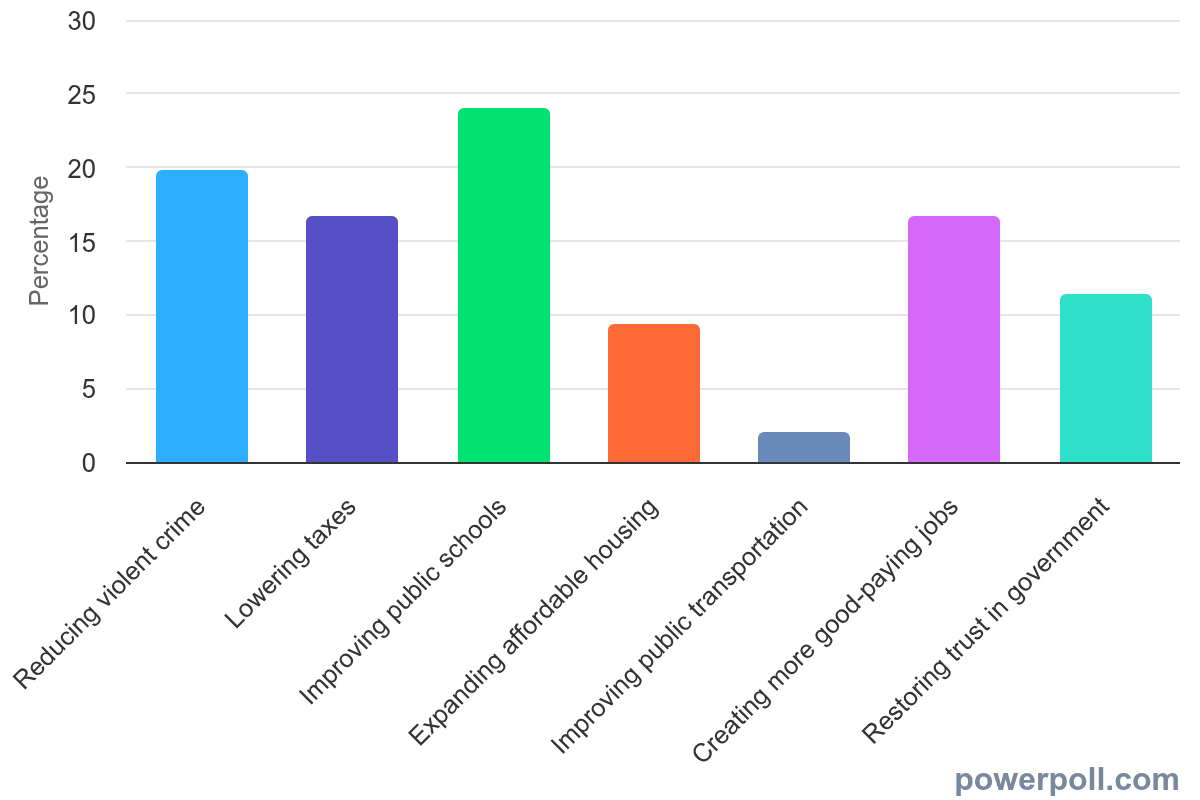
When asked to look beyond today’s frustrations and consider what would make the greatest difference over the next five years, Power Pollers shifted their focus to the classroom.
Improving public schools emerged as the leading priority at 24%, followed by reducing violent crime at 20%. Lowering taxes and creating more good-paying jobs tied at 17%, while restoring trust in government received 11%. Expanding affordable housing attracted 9%, and improving public transportation rounded out the responses at 2%.
The elevation of public education is especially noteworthy. Although schools placed third among the issues respondents believe Chicago’s leaders are not addressing effectively enough, they rose to first when Power Pollers were asked to identify a single achievement that City Hall should prioritize.
That distinction offers an interesting glimpse into how respondents separate immediate dissatisfaction from longer-term ambitions. Public safety and taxes may dominate today’s grievances, but education carries implications for workforce development, neighborhood stability, and the city’s ability to retain families in the years ahead.
The strong showing for violent crime reduction, tax relief, and job creation also underscores the breadth of the challenge. Our Power Pollers are not offering City Hall a single, uncomplicated mandate. They are expressing a desire for both immediate improvements and investments that could strengthen the city’s long-term prospects.
QUESTION 5: Should Chicago establish official daytime trick-or-treating hours this Halloween?
-
Yes, a unified citywide daytime schedule is necessary for safety, policing, and crowd management on a Saturday night – 55%
-
No, the city should maintain its current policy of leaving trick-or-treat hours unregulated and customized by individual neighborhoods – 30%
-
Undecided/Neutral – 15%
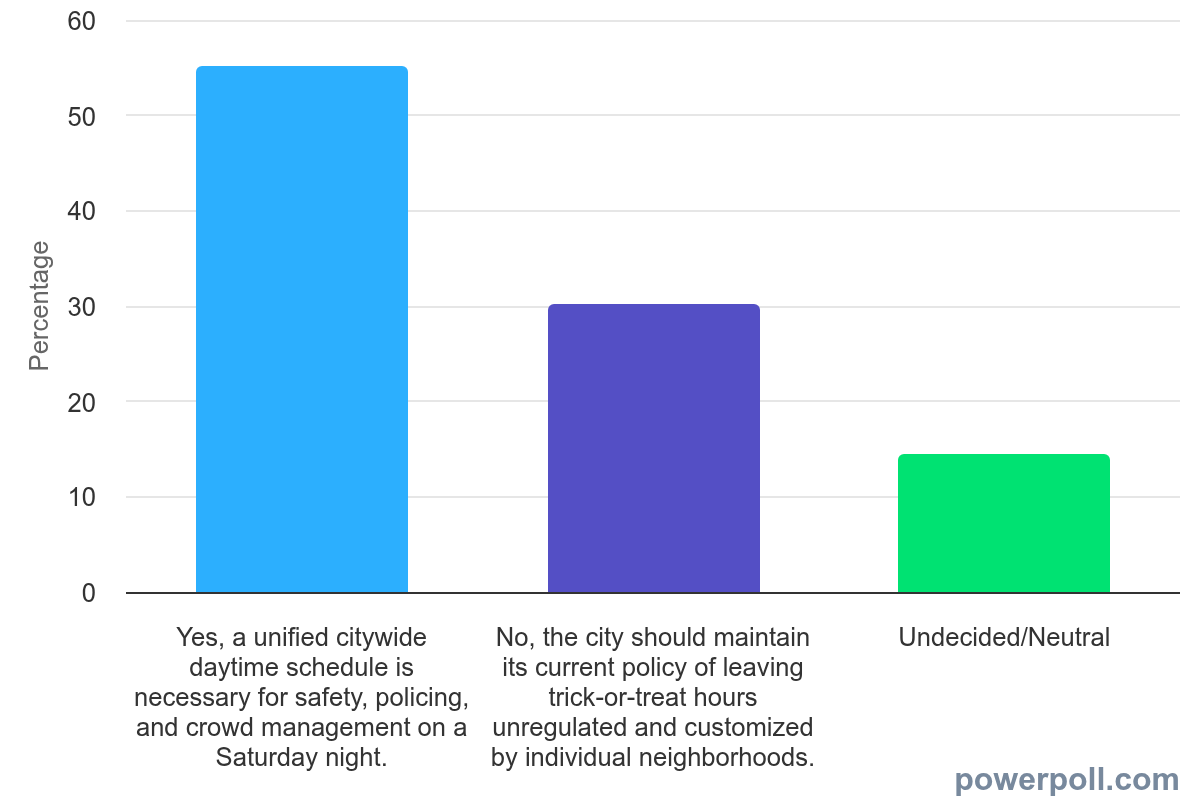
With Halloween falling on a Saturday this year, the prospect of earlier trick-or-treating hours has prompted a practical question for Chicago and its surrounding suburbs: Is it time to bring a little more structure to the spooky season?
A majority of Power Pollers, 55%, favored a unified citywide daytime trick-or-treating schedule to support public safety, policing, and crowd management. Meanwhile, 30% preferred preserving the city’s current neighborhood-by-neighborhood approach, and 15% remained undecided.
While considerably lighter than the month’s other questions, the results touch on a familiar Chicago balancing act: the advantages of citywide coordination versus the independence of its distinctive neighborhoods.
Supporters of designated hours may see an opportunity to provide consistency for families and public safety personnel, particularly with Halloween festivities extending into a Saturday evening. Others may prefer allowing neighborhoods to maintain the traditions and schedules that best suit their communities.
Whatever the outcome, this month’s Power Poll suggests that even Chicago’s Halloween customs can inspire a lively debate about how much coordination City Hall should provide.
The Takeaway
October’s Power Poll reveals a city wrestling with competing demands, but also a set of respondents whose concerns extend well beyond the headlines of the day.
Public safety and affordability share the spotlight as Chicago’s most inadequately addressed challenges, while taxes and government spending emerge as the subject most deserving of a frank public conversation. Yet when asked to envision a meaningful accomplishment over the next five years, Power Pollers placed public education at the forefront.
Perhaps the most intriguing finding is the division over Chicago’s population narrative, with equal shares of respondents identifying crime as a reason for departures and questioning whether those departures are as widespread as reported. It is a reminder that the city’s challenges are shaped not only by policy and economics, but also by public perception and confidence in its leadership.
For Chicago’s elected officials, the findings offer no shortage of issues to consider. The more difficult question is how to reconcile immediate demands for safer streets and lower costs with longer-term ambitions for stronger schools, economic opportunity, and effective government.
As Chicago approaches another election season and prepares for the challenges of the coming year, its Power Pollers have provided a revealing snapshot of the conversations unfolding across the city.
What do you think City Hall should prioritize? Add your voice to the next Power Poll.
The Serafin Power Poll, sponsored by Mercury Public Affairs, captures the perspectives of regional decision-makers and thought leaders in the Chicago metropolitan area. While not a scientific survey, it offers an insightful gauge of prevailing sentiments, much like a weathervane tracking the direction of Chicago’s political and civic winds.
Share this Post